 Lake Kawaguchi Tours
Best Time to See Mount Fuji From Lake Kawaguchi
Last reviewed September 2026
The best time to see Mount Fuji from Lake Kawaguchi is November through February, in the hour after sunrise. Fuji City's own 35-year observation record puts the whole mountain visible on about 134 days a year, and nearly all of them cluster in the cold months, when the Kawaguchiko side sees a view on 87 to 100 percent of January, November and December days, against a June low of 30 percent. None of that survives the morning. Visibility falls away after 11 a.m., sometimes as early as 9:30, because the same dry winter air that reveals the peak at dawn lets haze build over the lake by lunchtime, no matter how clear the sky looks from Tokyo.
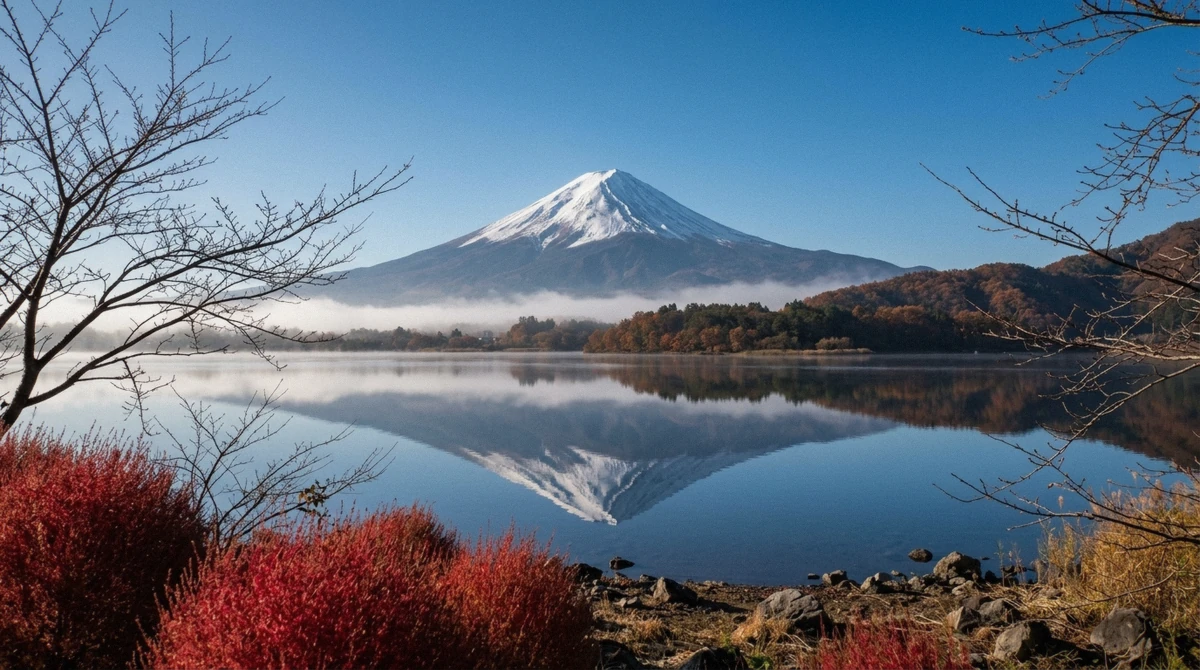
Quick answer November to February, before 11 in the morning, and why afternoons rarely count
The best window is November through February, before 11 in the morning. Fuji City's 35-year record shows the whole mountain visible on 4,684 of 12,784 days, about 134 days a year, and those days concentrate in winter, when the Kawaguchiko side runs 87 to 100 percent visible. June is the low point at 30 percent. Time of day matters as much as the month, since a peak that stands clear at 7 a.m. is often gone by 11.
Key takeaways
- Best window: November through February, mornings only; morning Lake Kawaguchi tours are timed around exactly this
- Runner-up: late October and early March, clear mornings without the coldest air, though the odds drop to 39 to 87 percent
- Avoid: June, when only 30 percent of days show any Fuji at all
- Counterintuitive: a blue sky over Tokyo says nothing about the mountain, since ground haze hides it even on sunny days from May to September
- Best hour: 6 to 8 in the morning, which is why the sunrise kayak launches at 07:00 and not later
- The hour you choose shapes which tour makes sense, see how the hour affects which tour to book
Seasons at a Glance
Read the Verdict column first: it is the short answer, the table beneath it is the evidence.
The four seasons at Lake Kawaguchi split cleanly on Fuji visibility. Winter's dry, stable air gives the clearest mornings of the year; summer's heat and humidity build haze that can hide the peak for weeks at a time. Spring and autumn sit in between, and the gap between the two is wider than most visitors expect.
| Season | Weather | Visibility | Crowds | Verdict |
|---|---|---|---|---|
| Winter (Dec to Feb) | Cold, dry, stable air | 87 to 100% of mornings | Quiet except New Year week | Best overall |
| Spring (Mar to May) | Warming, rain increasing | 73 to 87%, falling through May | High in early April | Good, hazier by May |
| Summer (Jun to Aug) | Hot, humid, heavy rain | 30 to 48%, the year's low | High around the lakes | Skip for Fuji |
| Autumn (Sep to Nov) | Cooling, driest by November | 39 to 97%, rebounding sharply | Moderate, high mid-November | November redeems it |
The jump from September's 50 percent to November's 97 percent is the single biggest swing on the calendar, and it happens in eight weeks.
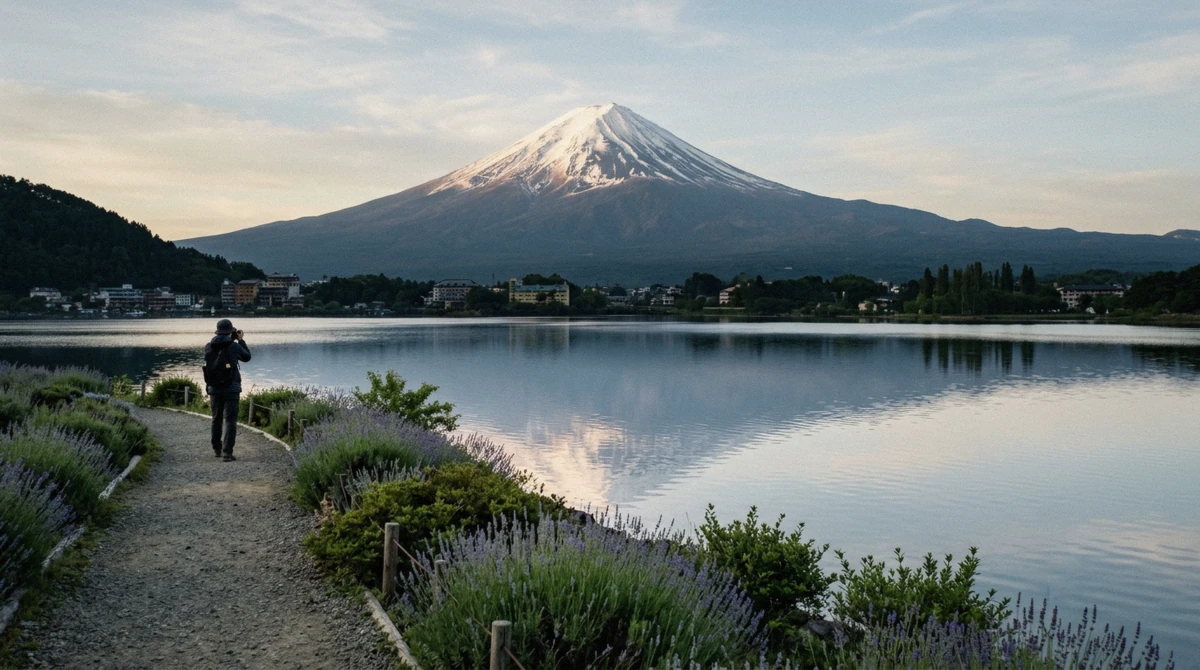
The Four Seasons at Lake Kawaguchi
Each season earns its own reason to come, and its own honest trade-off.
Winter (December to February): Clearest Mornings, Coldest Air
This is the season the visibility numbers point to directly. January runs coldest at a mean of -0.4 degrees Celsius (31 degrees Fahrenheit), yet it is also one of the two months with a 100 percent share of mornings showing at least a partial view, alongside November's methodology. December is the driest month of the year at 49.8 millimetres of rain, which is part of why the air stays so transparent.
Crowds are thin outside New Year week itself. The trade-off is obvious: dawn temperatures well below freezing mean warm layers are not optional, and the sunrise kayak lends a winter jacket, boots and gloves for exactly this stretch of the calendar.
- Mean temperature: -0.4°C (31°F) in January to 2.3°C (36°F) in December
- Visibility: 87 to 100% of mornings across the three months
- Quietest crowds of the year outside New Year week
Spring (March to May): Blossom Crowds, Thinning Visibility
Temperatures climb fast, from 4.2 degrees Celsius (40 degrees Fahrenheit) in March to 14.3 degrees Celsius (58 degrees Fahrenheit) in May, and visibility falls in step, from 87 percent in March to 74 percent in May. Traffic control runs around Arakurayama Sengen Park from 1 to 17 April regardless of the festival calendar, because the trees still bloom and the crowds still come.
Oishi Park's tulips and moss phlox flower from late April into early May, which is worth timing a trip around even when the mountain itself is less reliable than it was in February.
- Mean temperature: 4.2°C (40°F) in March to 14.3°C (58°F) in May
- Visibility falls from 87% to 74% across the season
- Traffic control near Sengen Park, 1 to 17 April
Summer (June to August): Rain, Haze, and the Lakes Instead
June is the worst month of the year for Fuji, visible on just 30 percent of mornings, and the rain does not help: June, July and August bring 157, 178 and 177 millimetres respectively, among the wettest stretches on the calendar. Humidity builds haze that can sit over the lake for days, and a clear blue sky in Tokyo says nothing about conditions here.
The honest advice is to come for the lake itself rather than for Fuji. Lavender flowers at Oishi Park from late June into mid-July, and the water is at its warmest for anyone still hoping for a glimpse between showers.
- Visibility: 30% in June, the lowest month of the year
- Rainfall: 157 to 178mm a month, June through August
- Lavender at Oishi Park, late June to mid-July
Autumn (September to November): November Redeems the Season
September is the wettest month of the entire year at 264.7 millimetres and one of the least reliable for Fuji at 50 percent, and October is not much better at 39 percent. Then November turns the season around almost overnight, back up to 97 percent as the rain drops to 76 millimetres and the air dries out.
The Momiji Corridor's autumn illumination runs 7 to 29 November, and the Japan Meteorological Corporation's own forecast puts peak colour around 16 November, which lines up with the best visibility week of the autumn. It is worth booking the full-day private tour around that window specifically, since the guide can shift the day's stops to catch a clear morning.
- September: wettest month of the year at 264.7mm, only 50% visibility
- November: visibility rebounds to 97% as rainfall drops to 76mm
- Momiji Corridor illumination, 7 to 29 November, peak colour near 16 November
Month by Month
Temperatures are the 1991 to 2020 normals from the Japan Meteorological Agency's Kawaguchiko station; visibility is the share of mornings with at least a partial view, from isfujivisible.com's archived forecast record for the north (Kawaguchiko) side.
August is the warmest month at 22.5°C (73°F) and September the wettest at 264.7mm; December is both the coldest close call and the driest, at 49.8mm. None of the three warm, wet months crack 50 percent visibility.
| Month | Mean Temperature | Rainfall | Share of Days With a View |
|---|---|---|---|
| January | -0.4°C (31°F) | 60.9 mm | 100% |
| February | 0.6°C (33°F) | 55.4 mm | 89% |
| March | 4.2°C (40°F) | 107.6 mm | 87% |
| April | 9.5°C (49°F) | 106.1 mm | 73% |
| May | 14.3°C (58°F) | 123.2 mm | 74% |
| June | 17.8°C (64°F) | 157.1 mm | 30% |
| July | 21.9°C (71°F) | 178.4 mm | 48% |
| August | 22.5°C (73°F) | 176.8 mm | 47% |
| September | 18.7°C (66°F) | 264.7 mm | 50% |
| October | 13.0°C (55°F) | 230.0 mm | 39% |
| November | 7.5°C (46°F) | 76.0 mm | 97% |
| December | 2.3°C (36°F) | 49.8 mm | 87% |
What Actually Affects Visibility
It is haze, not rain, that hides the mountain most often.
Most visitors assume a rainy forecast is the enemy and a sunny one is the answer. It is closer to the opposite. Warm, humid air over the Kanto plain builds a haze layer that sits over the lake through the day, and that haze forms whether or not it rains, which is why a clear blue sky over Tokyo does not mean the mountain will show from May to September.
Winter's cold, dry air holds far less moisture, so haze rarely forms at all, and a clear winter morning tends to stay clear for hours rather than burning off by nine. Fuji City's own 8 a.m. counts for 2025 make the gap concrete: February ran about 79% fully visible with only 7% full-view days closed off completely, while June managed just 7% full and 63% hidden entirely, and August still lost 65% of days to haze with no view at all.
- Haze forms from warm, humid air, independent of rain
- Cold, dry winter air holds little moisture, so clear mornings tend to last
- A sunny day in Tokyo is not evidence the peak is visible
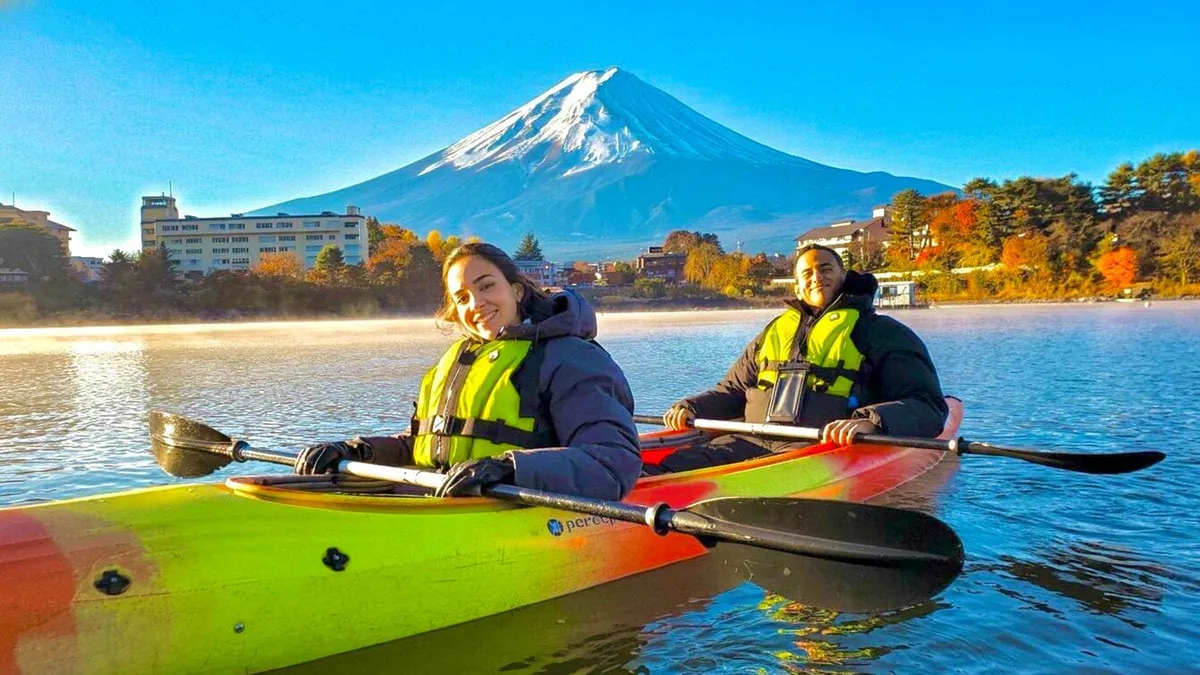
The Best Time of Day
The hour matters as much as the month, and it is the one variable every visitor controls directly.
Visibility is best between 6 and 8 in the morning and declines steadily after 11 a.m., on some days as early as 9:30. Arrive at the lakeshore by 7 and even a middling month has a real chance; arrive at noon and even January can disappoint.
Tour departure times follow this curve unevenly. The sunrise kayak launches at 07:00, squarely inside the best window. The scenic trike ride runs at 10:00 and 15:00, both already past the clearest hours, which is worth knowing before choosing between a guided ride and getting to the shore under your own steam at dawn. Tokyo day-trip coaches typically reach the lake around midday, well after the 11 a.m. decline, so a Tokyo departure trades the clearest light for a longer day out.
Once you are at the shore in that morning window, the Mt. Fuji Panoramic Ropeway is running from 8:30, with a car every few minutes up to a 1,075-metre deck for 1,000 yen return and the last car down at 17:20. The Ensoleille sightseeing boat does a 20-minute loop from Funatsu pier for about the same money, or a pedal boat runs 2,000 yen for half an hour if the group wants to be out on the water rather than looking at it.
Best Season by Traveller Type
If you want the clearest possible photos
come December to February and be at the shore by 7 a.m.
If you are chasing cherry blossoms too
come late March to mid-April and accept the lower 73 to 87% visibility odds
If you want lavender and warm-weather lake time more than a guaranteed view
come late June to mid-July, when Fuji shows on barely a third of mornings
If you want autumn colour and a clear peak in the same week
aim for 13 to 21 November, when visibility rebounds to 97% around the Momiji Corridor's peak colour
If you want thinner crowds and don't mind a coin-flip view
come in October, when visibility sits at 39% but the lake is quieter than September
What the Festivals Do to the Calendar
Two long-running events changed in 2026, and one new one is worth building a trip around.
The Arakurayama Sengen Park cherry blossom festival was cancelled outright, announced on 5 February 2026 by Fujiyoshida city over overtourism concerns. The park itself stayed open and the trees bloomed on schedule, but traffic control runs the surrounding streets from 1 to 17 April regardless, so the crowds the festival used to organise still show up unorganised.
Oishi Park's lavender Herb Festival is no longer held either, though the lavender itself still flowers from late June to mid-July without any event around it, and the park's tulips and moss phlox (late April to early May) and kochia turning red (mid to late October) continue on their own calendar.
The Momiji Corridor's autumn festival is the one addition: it runs 7 to 29 November 2026, 9:00 to 19:00, with illumination from sunset to 22:00. The Japan Meteorological Corporation's forecast, issued 2 September 2026, puts the best colour between 13 and 21 November and peak colour around 16 November, which is also one of the more reliable weeks for Fuji itself.
So, When Should You Go?
November through February, in the hour after sunrise, is the best time to see Mount Fuji from Lake Kawaguchi: the mountain shows on 87 to 100 percent of mornings in those months, against a June low of 30 percent. If you cannot travel in winter, late October and mid-November are the honest runners-up, and mid-November carries the added draw of the Momiji Corridor's peak colour. June is the one month to actively avoid if the mountain itself is the point of the trip.
Departure times for every listing sit on the Lake Kawaguchi tour catalogue page.
Questions About Timing Your Visit
What month is Mount Fuji most visible from Lake Kawaguchi?
January and November are the strongest single months on the Kawaguchiko side, both at or near 100 percent of mornings showing at least a partial view. December and February follow close behind at 87 to 89 percent. June is the weakest month at 30 percent.
What time of day is best to see Mount Fuji?
Between 6 and 8 in the morning. Visibility declines steadily after 11 a.m. and on some days starts fading as early as 9:30, so the sunrise kayak at 07:00 sits inside the best window in a way a midday arrival cannot match.
How do I know if Mount Fuji will be visible today?
There is no way to guarantee it, but a cold, dry, low-humidity forecast is a far better sign than a simply sunny one, since haze builds independently of rain. Local forecast sites that track Fuji visibility specifically are more useful than a general weather app for this one question.
Is Lake Kawaguchi or Hakone better for seeing Mount Fuji?
On the numbers, Kawaguchiko has the edge most months: its north-side visibility runs ahead of Hakone's in nine months of the twelve, most sharply in spring, when Kawaguchiko holds 73 to 87 percent against Hakone's 52 to 61 percent. Hakone's summer numbers are worse still, down to 17 percent in June against Kawaguchiko's 30.
Can you see Mount Fuji with snow, and when is that most likely?
The summit typically carries snow from around November through April, so the same winter window that gives the clearest views also gives the classic snow-capped look. By May the cap has usually thinned considerably.
Does a clear day in Tokyo mean Fuji will be visible from the lake?
No. Warm, humid air builds a haze layer over the Kanto plain from May to September regardless of rain, so a sunny day in the city tells you almost nothing about whether the mountain will show 80 kilometres away.
What's the best time to see Fuji without the biggest crowds?
Mid to late November, just after the Momiji Corridor's peak colour week, combines strong visibility (still near 90 percent into early December) with crowds well below the New Year and cherry blossom peaks.
Nothing here rewards flexibility more than the hour of your arrival. A traveller locked into a July date can still win by getting to the shore at dawn; a traveller with the whole calendar open should simply pick a morning in December, January or February and let the odds do the rest.